
Joey Mui responds to the Australian Financial Review's forum on super funds, passive investing and the future of active management (AFR, 13 September 2026).
The AFR's forum on the state of Australia's equity market was, for the most part, a conversation about adaptation. The backdrop, as it reported:
- Frontier Advisors' data showing active managers trailing the S&P/ASX 300 in each of the past three financial years.
- Your Future Your Super pushing asset owners towards passive and systematic strategies.
- Index flows crowding into the top ten names.
- A common frustration that prices and fundamentals have come apart.
The industry's question is how active managers can adapt to compete in a market increasingly priced by algorithms. Some, including one of the super funds at the forum, point to quant-style dashboards that factor in programmatic behaviour. We have used dashboards in our own process for over a decade. We find them helpful, but they aren't a silver bullet, and we are unlikely to have the technological edge to out-execute a well-funded systematic hedge fund.
The more useful question is what the machines have left behind.
The easy ride has been taken
For most of the last fifteen years, a great deal of alpha in Australia came from earnings momentum and quality, in an interest rate environment that favoured long-duration growth. Buy a company in an earnings upgrade cycle, regardless of the multiple. It worked, and it worked long enough that a generation of investors perhaps forgot the lessons of the past.
That trade is now increasingly systematised. Factor models identify earnings surprises and momentum faster and more cheaply, and index flows reinforce the same names by construction. Meanwhile, earnings misses are punished almost indiscriminately, without regard to the underlying earnings power and cycle of the business.
So the alpha isn't gone. But it is harder to capture in a crowded space, and more often captured by algorithmic traders than by large institutional funds. We think the future will look very different, with alpha available to those willing to deviate further from the crowd.
Turning volatility into opportunity
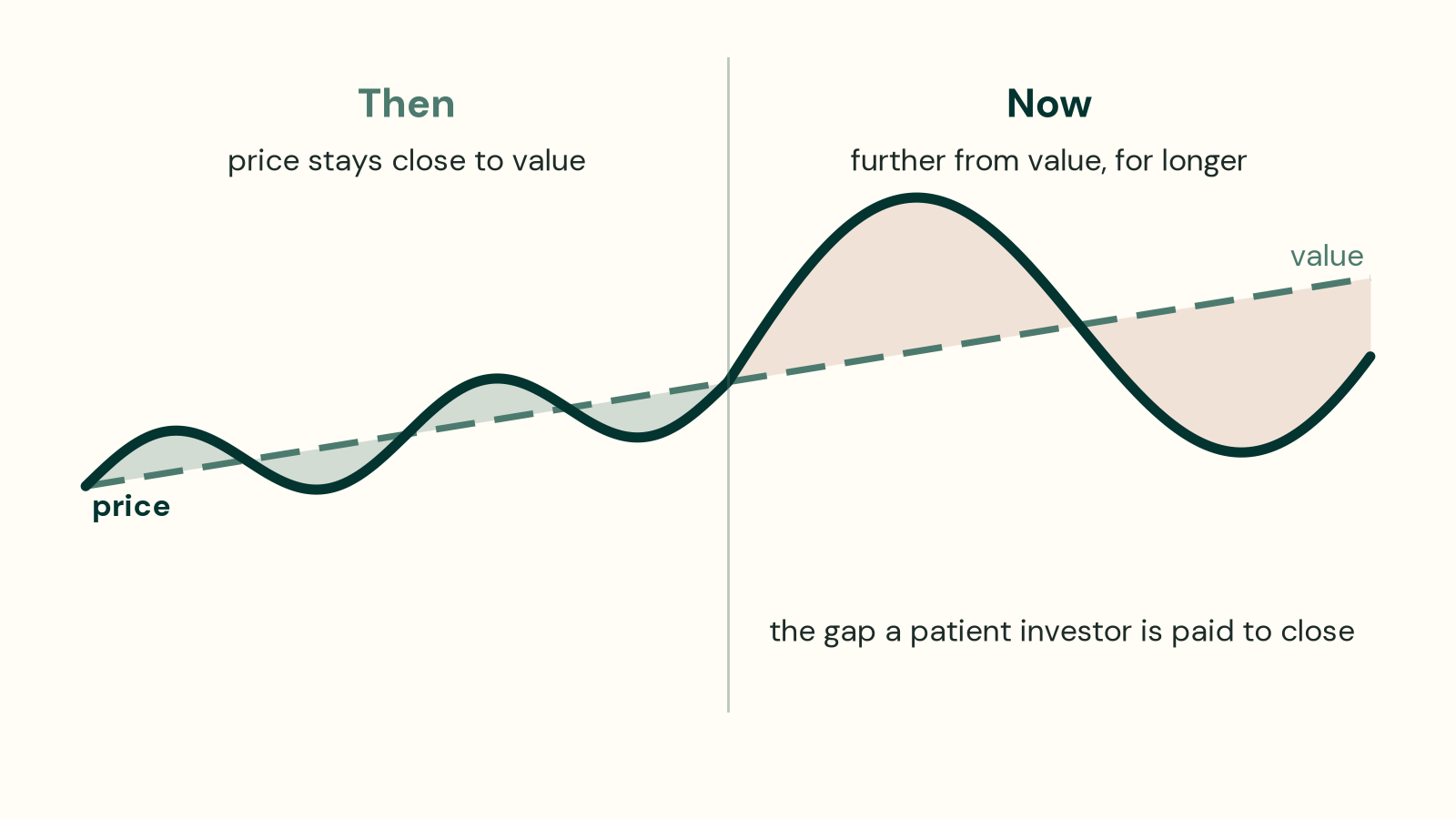
Take Woolworths, which our funds held through the period. It closed September 2025 at $26.70 and June 2026 at $40.03, nine months later, without the underlying business changing materially. Examples like that point to a price discovery mechanism that is broken, or at least much slower than it used to be.
We think this is excellent news for active managers. If prices now spend longer and further from fundamental value, then the compensation available for being long term has gone up, not down.
Play the long game
If the short game now belongs to the machines, the rational response is not to contest it but to vacate it, deliberately. That means looking at companies with little or negative momentum and no programmatic crowd behind them. Volatility is only an advantage if you are not standing where the machines are when it arrives. If your portfolio shares in the momentum complex, systematic flows are a risk to you: you own what they own, and you get repriced when they reprice.
If your portfolio sits in the unloved end of the market, in businesses the factor models are actively discouraged from owning, volatility is a friend that creates an attractive entry price. Value investing spent a decade overshadowed by its growth peers. Today, the ability to buy at deep, out-of-favour discounts is the antidote to the dislocation that systematic trading creates.
Long-term fundamental investing also earns a standing that programmatic or passive funds cannot replicate. When the marginal price-setter is indifferent to strategy and capital allocation, boards hear less from owners than they used to. An active engagement agenda with management and boards, on capital discipline, externalities and governance, is open only to those who understand the business, wait patiently on the register and are willing to engage.
Sea change
What all of this requires is capital that can tolerate the path. If prices spend longer away from intrinsic value, the holding period needed to capture the convergence lengthens with it. For those focused on tracking error, that gets harder as alpha moves further from the index. For those bold enough to deviate from the index and be patient, we think opportunities for alpha have never been better.
The next decade of excess returns is far more likely to be found among the businesses the index and momentum trades have discarded than among the twenty large stocks they cannot stop buying.
The machines have taken the easy trade. What's left is the one worth doing.
.jpg)