
Two numbers appear in almost every fund review: tracking error and volatility. They are often read as if they measured the same thing, and a fund with low tracking error is often assumed to be the safer choice.
They measure different things. Confusing them can lead an adviser to pay active fees for a portfolio that carries all of the market's risk, and in Australian equities that combination is common.
What each number measures
Volatility measures how much a fund's returns move up and down. It is the standard deviation of returns, usually annualised. It is the closest single number to what a client actually experiences: the size of the swings in their account.
Tracking error measures how differently a fund's returns move from its index. It is the standard deviation of the difference between the fund's return and the index's return. It says how far a fund strays from the index. It says nothing about whether the fund is volatile, and nothing about whether being different has been good or bad.
A fund can be very different from the index and still be steady. A fund can hug the index closely and still swing as hard as the market does, because the market is what it is hugging.
Why the difference matters
Put the two measures on a grid and four kinds of fund appear.
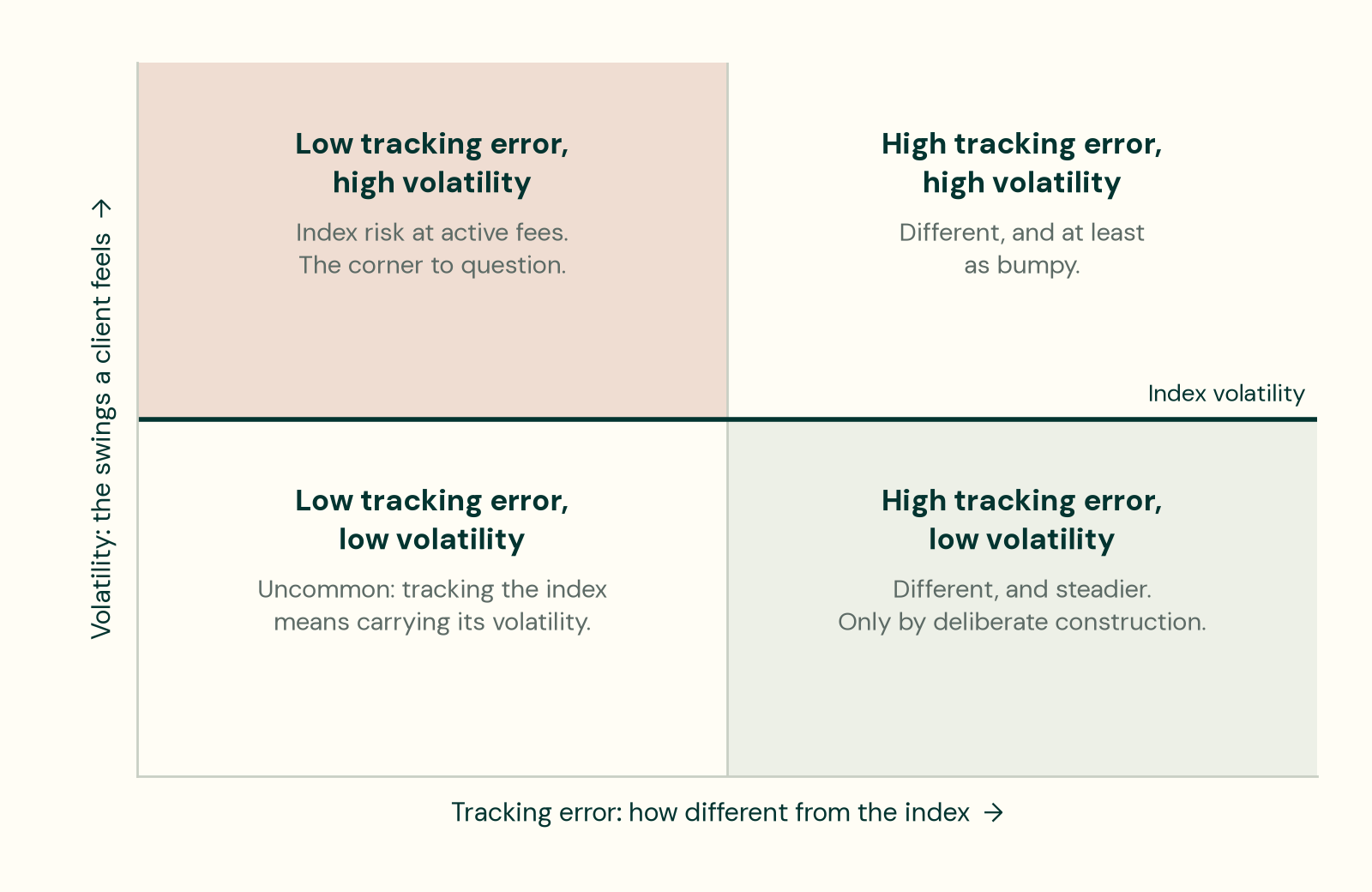
- Low tracking error, high volatility. The fund looks and moves like the index. The client carries the market's full risk and pays an active fee for it. This is the corner that deserves the most scrutiny, and it is the one a low tracking error figure can make look safe.
- High tracking error, high volatility. Different from the index, and at least as bumpy. The difference may be rewarded, but the client should expect a rough ride.
- Low tracking error, low volatility. Uncommon in Australian equities, since tracking the index closely means carrying most of its volatility.
- High tracking error, low volatility. Different from the index, and steadier than it. A fund only reaches this corner deliberately, through the way its portfolio is built.
The industry's habit of calling tracking error "risk" treats the left-hand side of that grid as the goal. For a client, the question is closer to the reverse: is the fund's difference from the index buying a better experience, or just a different one?
What clients are paying for
An active fee pays for a portfolio that is different from the index. An index fund delivers the index for a small fraction of an active fee. So the more closely an active fund tracks the index, the less a client is getting for the active part of the fee.
The Australian market shows how often that goes unexamined. Across 135 large and mid-cap Australian share funds with a five-year record:
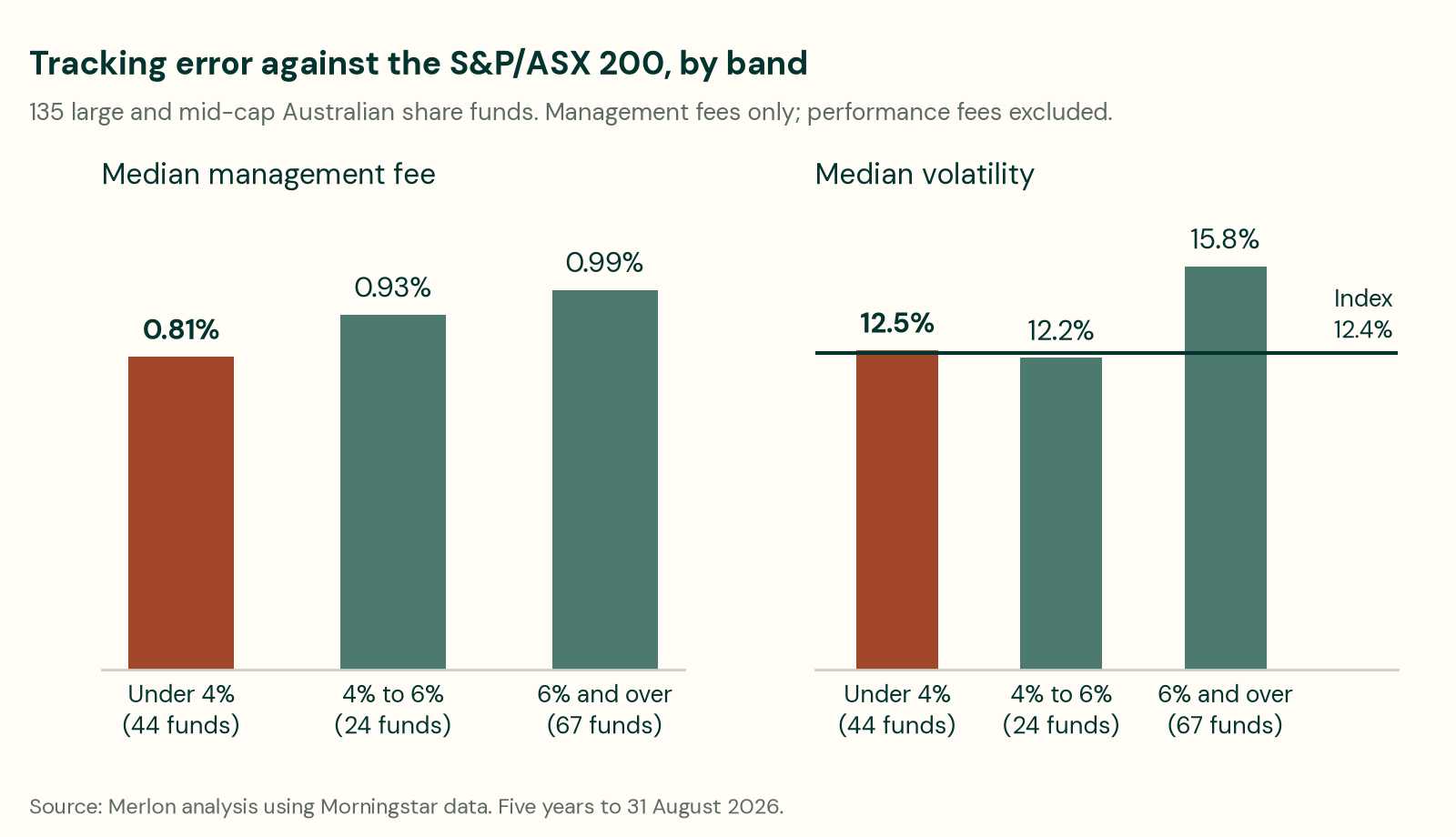
The 44 funds closest to the index charged a median management fee of 0.81% a year, not far below the 0.99% charged by the most active funds. Their median volatility, 12.5%, was essentially the index's. Measured per 1% of difference from the index, they charged more than twice as much as the most active funds: 0.27% against 0.12%.
A client in one of those funds pays close to a full active fee, carries the market's full volatility, and receives a portfolio that differs from the index by around 3% a year. That is a poor use of a client's money, and it is the combination a low tracking error figure can make look prudent.
The chart also shows why the most active funds are not automatically the answer: as a group, they were considerably more volatile than the index.
A worked example
Here are the same measures for Merlon's two funds against the S&P/ASX 200 Accumulation Index.
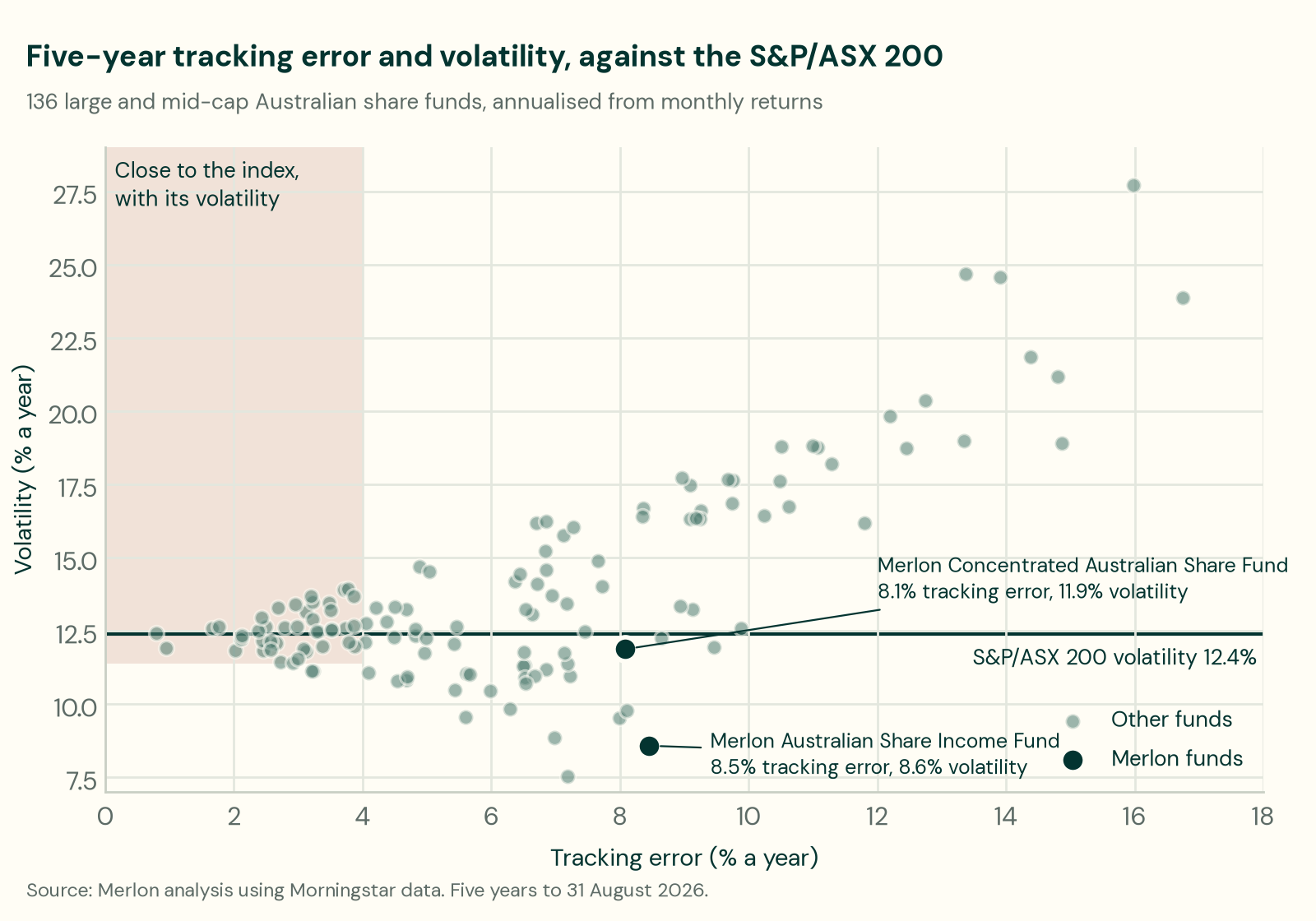
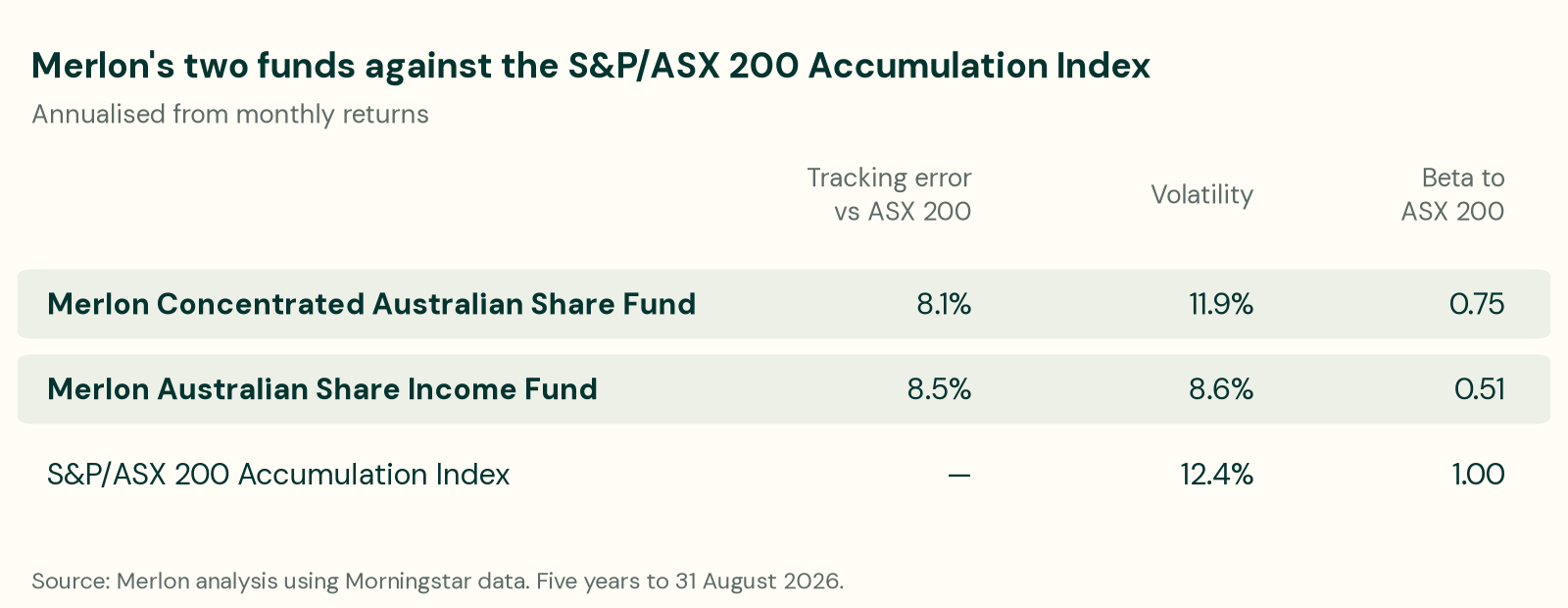
Three things are worth reading from it.
Both funds are a long way from the index. Each has a tracking error above 8%, higher than around 70% of the 136 large and mid-cap funds with a five-year record. Our portfolios are constructed without regard to index weights, so that is expected.
That difference has not added volatility. Most funds that active were considerably more volatile than the index. The Concentrated fund's volatility, 11.9%, is close to the index's 12.4% and slightly below it. A fund can be very different from the market without being more volatile than it.
The Income fund is materially smoother. Its volatility of 8.6% is around 30% lower than the index's, and its beta of 0.51 means it has tended to move about half as much as the market. That is partly by design: the fund pairs its share portfolio with a yield and hedge overlay. Its own benchmark is 70% S&P/ASX 200 Accumulation Index and 30% Bloomberg AusBond Bank Bill Index, rather than the ASX 200 alone. We compare it with the ASX 200 here because the question is how different it is from the index.
What the numbers do not tell you
They do not tell you whether the difference was worth it. Tracking error measures the size of a fund's difference from the index, not its direction. Whether investors were rewarded for that difference is a separate question, which a later lesson on information and Sharpe ratios takes up.
Volatility is not the only risk. Standard deviation treats a sharp rise the same as a sharp fall. How a fund behaves when markets fall, and how deep its losses run, need their own measures.
The management fee is not the whole cost. Many funds also charge a performance fee, and those are excluded from the fee figures above. They are more common among the more active funds, so including them would widen the gap between what the most active funds charge and what the least active ones do.
The window matters. Five years is long enough to include more than one market environment and short enough to reflect how a portfolio is run today. A different window will give different numbers, and anyone comparing funds should use the same window for each.
How to check a fund yourself
- Ask for both numbers, over the same window and on the same basis. A tracking error with no volatility beside it tells half the story.
- Check the index. Tracking error is always measured against something. Make sure it is the index your client's money would otherwise be in.
- Set the fee against the tracking error. A fund charging close to a full active fee while staying within a few per cent of the index deserves a direct question about what the fee is buying.
- Place the fund on the grid. Low tracking error with volatility close to the index's is the corner to question hardest.
The most useful question is not "how far from the index is this fund?" but "what is that difference, and its fee, doing for my client?"
.jpg)