

News & Insights

The investor's blind spots: five biases your clients will recognise

The investor's blind spots: five biases your clients will recognise

A summary of Kirit Hira's field guide to behavioural bias in equity investing.

Markets are a mechanism for aggregating human psychology into prices. That psychology is biased in ways an attentive observer can spot, first in others and then, with some humility, in oneself.

Our portfolio manager Kirit Hira has written a short field guide to seventeen of these biases. Each one pairs the research with an everyday example and a takeaway. Every bias in it is one we at Merlon have walked into at some point. The goal, as the foreword puts it, is not to be free of them. That goal is not available to anyone. The goal is to recognise their footprints.

Five of the seventeen come up again and again in conversations with clients.

1. Loss aversion

The pain of losing a dollar bites roughly twice as hard as the pleasure of finding one. Kahneman and Tversky's 1979 work on prospect theory put the ratio at between two and two-and-a-half times, and it has been replicated across cultures, asset classes and decades.

The cost shows up as reluctance to sell. "The investor who cannot tolerate small losses will, sooner or later, hold onto large ones."

An engraving of a man in a suit standing under an umbrella in a leaking rowing boat, eyes closed, while a lifeboat marked Not my problem sits on the beach behind him.
Loss aversion, from the guide.

2. The disposition effect

Investors sell their winners too early and hold their losers too long. In 1998 Terrance Odean studied around ten thousand brokerage accounts. He found investors sold winning stocks at a rate fifty per cent higher than losers, and the winners they sold went on to outperform the losers they kept over the following year.

"Your portfolio has no memory of what you paid for each position. Neither should your decisions. The only question that matters is: does this deserve a seat in the portfolio today?"

3. Anchoring

The first price you see, the price you paid, the fifty-two-week high: each becomes a reference point that drags later judgement towards it, whether or not it bears on the question. In Kahneman and Tversky's experiment, a wheel of fortune that had nothing to do with the question visibly moved people's estimates.

"The price you paid for a stock is not a fact about the stock. It is a fact about your autobiography."

An engraving of a sailing ship held in place by a heavy anchor on the seabed while other ships move past it.
Anchoring, from the guide.

4. Herding

When we are uncertain, we look to others for clues. In Solomon Asch's 1951 conformity experiments, three in four subjects went along with a group's obviously wrong answer at least once. At market scale, this is how bubbles form, and how they end.

"You cannot do what the crowd does and expect a different result from the crowd. Which means: most of the time, you will feel uncomfortable. Discomfort is not evidence of error. It is often evidence of opportunity."

5. Hindsight bias

After the fact, the genuinely uncertain past rewrites itself as inevitable. In Baruch Fischhoff's studies, people consistently remembered giving higher odds to what actually happened than they had at the time. The practical danger is that we learn far less from experience than we think we do.

"If everyone saw it coming, nobody did. Keep a journal of your forecasts, date them, and read them back in a year."

The question that cuts through

Several of these biases have the same antidote. Loss aversion, the disposition effect, anchoring and the sunk cost fallacy all depend on the price you paid. The guide's remedy is to ask one question of every holding: if I did not already own this, would I buy it today?

That question works for a client's portfolio. It works equally well for a fund manager on an approved product list.

The afterword ends on a hopeful note. The market does not require us to be perfectly rational, only somewhat less irrational than whoever is on the other side of the trade. That bar can be cleared by building habits, processes and relationships that catch us at the moments we are most reliably ourselves.

The full guide covers seventeen biases, with a starter reading list.
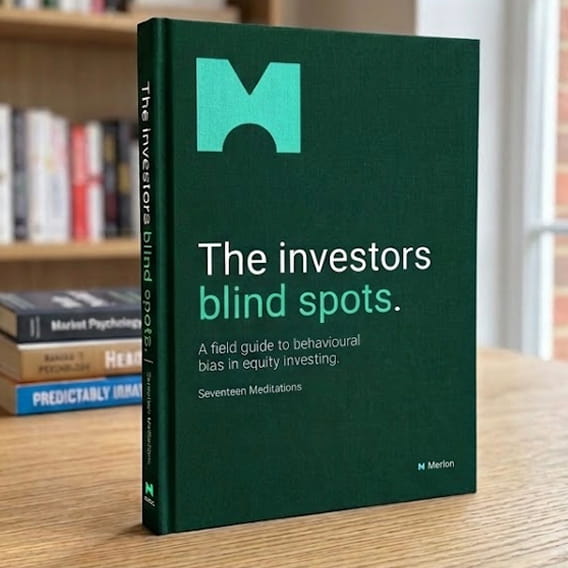
Author: Kirit Hira/Portfolio Manager

eBook

The Investor’s Blind Spots

A field guide to behavioural bias in equity investing.

Over decades in this business, we have come to believe that the investor’s most valuable instrument is not a spreadsheet or a terminal or even a well-stocked network of contacts. It is a mirror....

Thank you - your copy is ready.
Download eBook
Oops! Something went wrong while submitting the form.

Disclaimer.

This document has been prepared by Merlon Capital Partners Pty Limited (ABN 94 140 833 683 / AFSL 343 753) (Merlon).

The advice contained in this document is general advice. It has been prepared without taking account of your objectives, financial situation or needs and because of that, you should, before acting on the advice, consider the appropriateness of the advice, having regard to your personal circumstances. You should also consult a licensed financial adviser before making an investment decision.

Any investment in a Merlon Fund (Fund) needs to be made in accordance with the Product Disclosure Statement (PDS), Additional Information Booklet and Target Market Determination (TMD). Investors should consider the PDS, Additional Information Booklet and TMD before deciding whether to invest in a Fund or continue to hold units in a Fund. Applications for units in a Fund can only be made pursuant to the application form relevant to that Fund. Distributors of our products must consider our TMD. You can access the relevant PDS, Additional Information Booklet and TMD at the Merlon website: https://www.merloncapital.com.au/

Any projections contained in this communication are estimates only. Such projections are subject to market influences and contingent upon matters outside our control and therefore may not be realised in the future. Investing involves risk including the risk of loss of principal. Please note that investments are subject to market and other risks and there is no assurance or guarantee that the intended investment objectives will be achieved. An investment's return and an investor’s principal value will fluctuate so that, when redeemed, an investment may be worth more or less than their original cost. An investment's current performance may be lower or higher than the investment performance noted within the article. Past performance is not a reliable indicator of future performance. Any reference to past performance in this article is intended to be for general illustrative purposes only and should not be relied upon.

While we believe the information contained in this article is based on reliable information, no representation or warranty, express or implied, is made as to the accuracy or completeness of the information and opinions contained in the article. While every care has been taken in the preparation of this material, to the fullest extent permitted by law, Merlon its respective officers, directors, employees or agents, disclaim any and all liabilities for any loss or damage (including consequential loss or damage) howsoever arising in connection with the use of this article or its contents.

Definition of success

“Success is a culture of integrity, passion and purpose. Deep client trust. Investment outcomes
worth the trust. A business built to outlast us.”

Stay close to the thinking.Insights from the Merlon team — delivered occasionally, not constantly.

Thank you! Your submission has been received!
Oops! Something went wrong while submitting the form.