

In October, Firmus withdrew what would have been the largest Australian float in almost thirty years: an A$7.1 billion offer at an implied value of about A$43.7 billion, pulled on 9 October, two weeks before trading was due to begin. While many Australian fund managers formed a view on it from Sydney, we spent part of this month in Malaysia meeting the people who build and operate this capacity.
Two of Firmus's major projects are being built there, alongside peers AirTrunk, Bitdeer, DayOne and Bridge. What we found was a business with a real cost advantage that we think belongs more to the place than to the company, but a wave of capacity over the next two years poses significant risk.
The key risk: a significant amount of leading-edge (newest) GPU capacity is being built to service the training requirements of hyperscalers — the handful of global cloud providers that account for most of this demand — and of frontier AI models over 2027/28. What happens when AI model improvement becomes incremental and does not require as much of it?
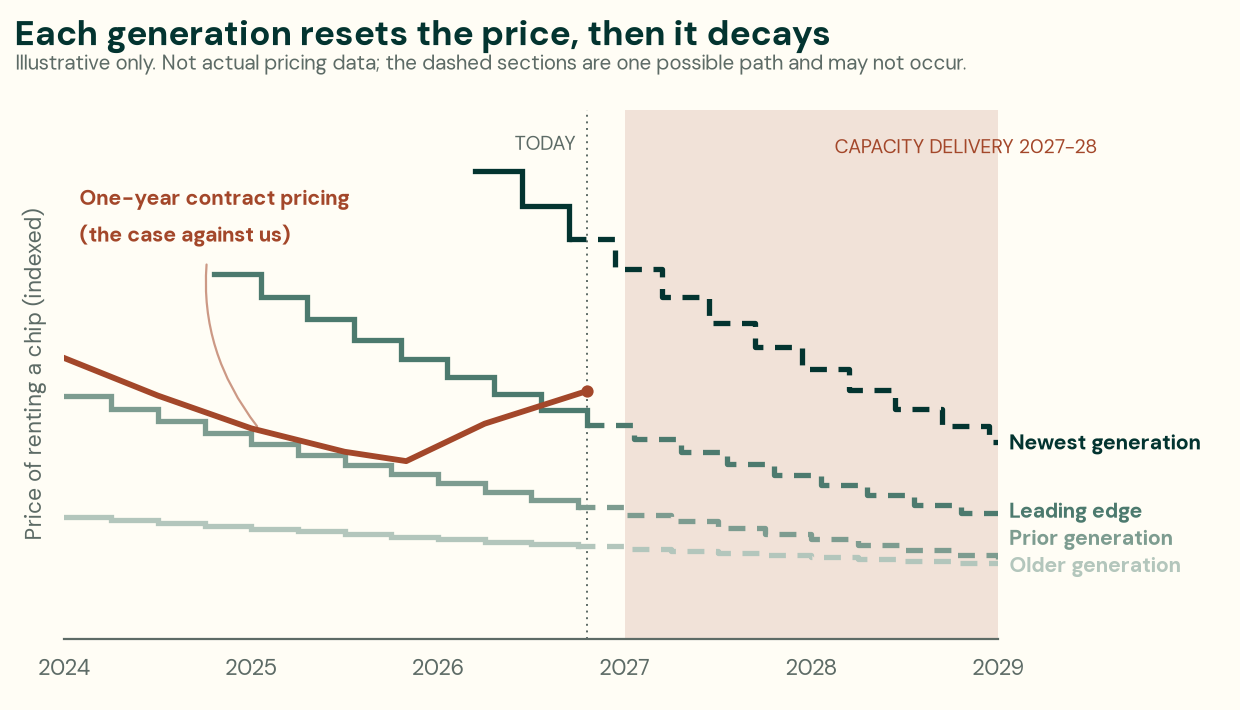
We worry that we will see significant over-capacity in two years' time, because there is a real risk of large amounts of excess fixed capital accepting a return below its cost of funding rather than earning nothing at all. The reason is that computing capacity is not consumed when it is superseded: halls built for this generation of chips do not disappear when the next arrives; they get cheaper and keep competing. Technology and economics will keep evolving, and this is our reading of one possible outcome rather than a forecast — it may not occur.
An alternative to our view is that Firmus is backed by Nvidia and has signed OpenAI as an anchor customer for both of its Malaysian sites, taking contracted capacity across its customers above 900 megawatts — a strong book by any measure. Demand still seems strong from hyperscalers, and more can arrive as new AI model developers are funded. And while the spot price of renting a chip has fallen hard, one-year contract pricing has moved the other way, rising roughly 40% from its late-2025 low as on-demand capacity sold out. Some constraints on supply are also beginning to appear, with Malaysia restricting its data centre approvals, a power tariff for data centres and a pause on new water-cooled capacity — which extends Firmus's advantage for projects already sanctioned.
We should also say that Firmus did not make its prospectus publicly available. Putting the company's own case was therefore harder than it usually is, and what follows is our reading of a business we could not read in full.
Three things to watch
- The cost advantage is real, but replicable. Firmus's partnership with DayOne and geographic exposure to Malaysia and Indonesia does offer genuine cost advantages. Builders with Chinese parentage — DayOne is the international arm of GDS Holdings; Bridge, now Bain Capital-owned, came out of Chindata — have an early lead on land, power, build efficiency and labour. The people building there put their costs 20–30% below those of multinational builders such as AirTrunk and Vantage, and the public record points the same way: wholesale space in Johor rents for something like a third of the Singapore equivalent. Firmus's much-touted immersion cooling technology, where the computers sit in fluid rather than moving air, is cost efficient although it is relatively easy to replicate and can be leapfrogged by other technologies.
- A step-up in capacity could create oversupply in 2027-28. Some of the people we met described contract rates for new capacity roughly halving. The published pipeline says why that is plausible: Johor had about 1,110 megawatts of live capacity in the first half of this year, some 600 more under construction and a development pipeline in the thousands, and Malaysian capacity is expected to roughly double by the end of 2026. This is counter to the consensus view that demand is overwhelming the industry's ability to build and supply data centres. Lagging-edge (older) capacity sticks around, there is plenty of land for new, and so the stock keeps accumulating. The central concern is what happens to the price of renting GPUs once leading-edge chips are superseded.
- Counterparty risk sits beyond five-year contracts. The data centre builders we spoke to described breakeven points stretching from five years towards seven or eight, which highlights lower returns on capital as excess demand is increasingly met by additional supply. It is unclear what happens if GPUs are no longer needed for training, unless another big leap emerges. Contacts suggested they had seen contracted capacity cancelled and chips on-sold elsewhere. We have not verified that, and it is worth weighing accordingly — but if it is representative, contracted demand among the smaller providers chasing customers outside the hyperscalers is thinner and less consistent than the headline numbers suggest, which is a question for every link in the chain, the chip makers included.
Why we spend time on the ground
Merlon does not generally participate in initial public offerings. We are usually less informed than the seller, our incentives and theirs are not the same, and a float rarely comes with enough history to judge whether the cash flows are sustainable. That is a general position rather than a view about this company.
What the trip was about is forming a deeper understanding of the industries that drive our market. Understanding the value chain and its economics is central to how we assess both the opportunities and the threats — and the question that decides most of it is how any value created ends up being appropriated: between the companies we invest in, their AI suppliers, and their customers. Doing the hard work beyond the numbers in the spreadsheet is how we build conviction in our investment ideas, or find the evidence that dispels them. That is what we went to look at, and it is why we will keep going to look.
The float did not proceed, for reasons that had nothing to do with us: investors baulked at a price implying more than double the company's own August funding round. Regardless, our process and philosophy compel us to do the homework and build our knowledge base — so that where our conviction meets opportunity, we are ready.
