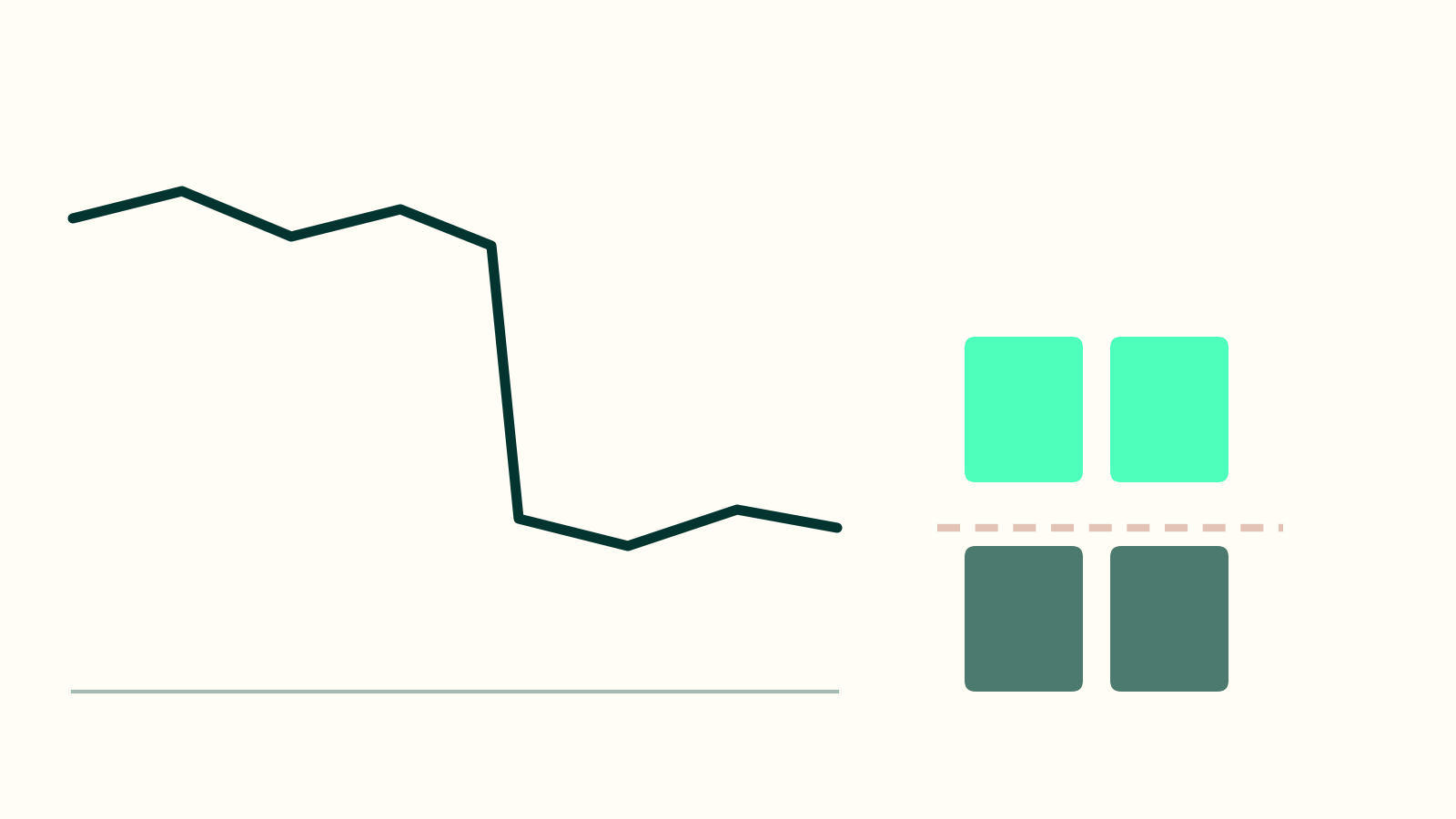

Neil Margolis on the path from a 40% one-day fall to a place in the portfolio.
Most stories about a stock start with the answer. This one starts with a company we had looked at for a year and deliberately not bought.
A year of saying no
We first looked hard at Judo Capital in mid-2025: an initial view in July, a meeting with management in August, and calls with former executives in September. We liked the business, a relationship-led lender to small and medium businesses, with a lending margin the major banks struggle to match. But our view of the downside, what we would lose if things went wrong, sat too close to where the shares were trading. That low case kept us out.
The fall
On 25 June 2026 Judo released a trading update disclosing a group of problem loans and guidance below market expectations. The market value of the company fell by about 40% in a day, from about $1.7 billion to about $1.0 billion. The shares went from trading at roughly their book value to about 0.6 times it.
Falls like that are when the questions we care about get asked. Was the market right that something had broken, or had it priced a contained problem as a structural one?

The model portfolio raises its hand
Our process includes a model portfolio that sizes each stock from our valuation, our conviction and the risk it adds. After the fall Judo moved up the rankings in it, and we raised our conviction. We don't treat the model's signal as a decision; we treat it as a prompt to do the work.
The work
The question was the one the market had already answered: was this a failure of credit culture across the book, or a contained problem?
We did most of the work before buying a share. That meant revisiting our earlier research, then speaking with investor relations, former employees, a former broker to the bank and a governance adviser, and running a programme of expert calls. The evidence pointed to a contained problem. We concluded the market's concerns about structural credit failure, broker alignment and the scalability of the model were overdone.
Starting the position
We bought our first shares in early July and built towards half of our target weight. At the same time we drafted a letter to Judo's board, setting out why we had invested and what we think matters for long-term shareholders. As with every letter we send, it was reviewed by our investment team before going any further.
The Advisory Board
Our process asks us to stop at about half of the target weight and present the case to our Advisory Board before going further. Neil presented Judo in July: the case, the risks and what would change our minds. The board's job is to test the thinking rather than approve the trade. It also reviewed the letter.
Completing the position
With the board's challenge answered, we built the position to its full size and sent the letter to Judo's board. We have since met the chief executive and chief financial officer, a non-executive director and, most recently, the chair. Owning a company means continuing to test the thesis, not just holding it.
Where it ended up
The position is now complete, at about 1.5% of the Concentrated Australian Share Fund. That is smaller than we would usually hold at this level of conviction. The limit is liquidity rather than conviction. Judo is a small company, worth about $1 billion on the sharemarket and a very small part of the index. We cap every position at a multiple of its index weight, so that we could sell in a reasonable time if we had to. For a company Judo's size, that cap binds well before the 5% we would normally treat as the most we hold in a single stock.
Why tell this story
Much of what we look for sits where the market's recent experience is worst. The price had fallen, the story was bad, and nobody was in a hurry to own it. That discomfort is not proof of opportunity, but it is often where opportunity is found. What turns it into a position is the work: a year of saying no, weeks of asking hard questions before buying, and a pause at half weight for our Advisory Board to push back.
.jpg)