

We had never owned CSL.
For most of the period since Merlon's inception it was one of the largest companies in the country: in March 2020 it was 9.9% of the S&P/ASX 200, the largest weight in the index, ahead of both Commonwealth Bank and BHP. We owned none of it.
Then on 13 January 2026 we bought our first shares, and by late August the position was close to 6% of the fund. Two days after that we started selling, and we have been selling since.
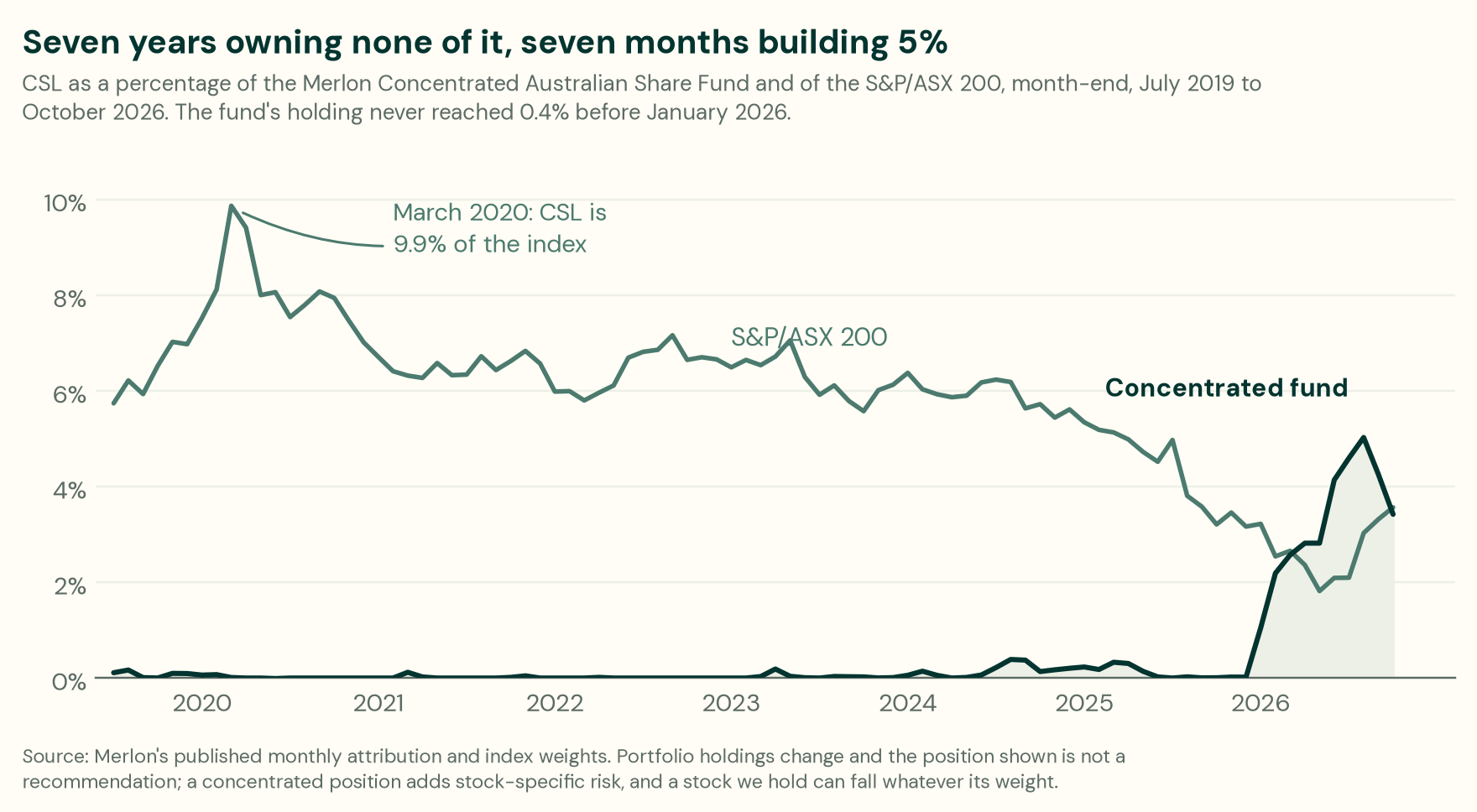
That sequence looks like a contradiction. We call ourselves long-term investors, and this was seven months. It's worthy of explanation.
Why we would not own it
The question was never whether CSL is a good business. It is. The question was the price.
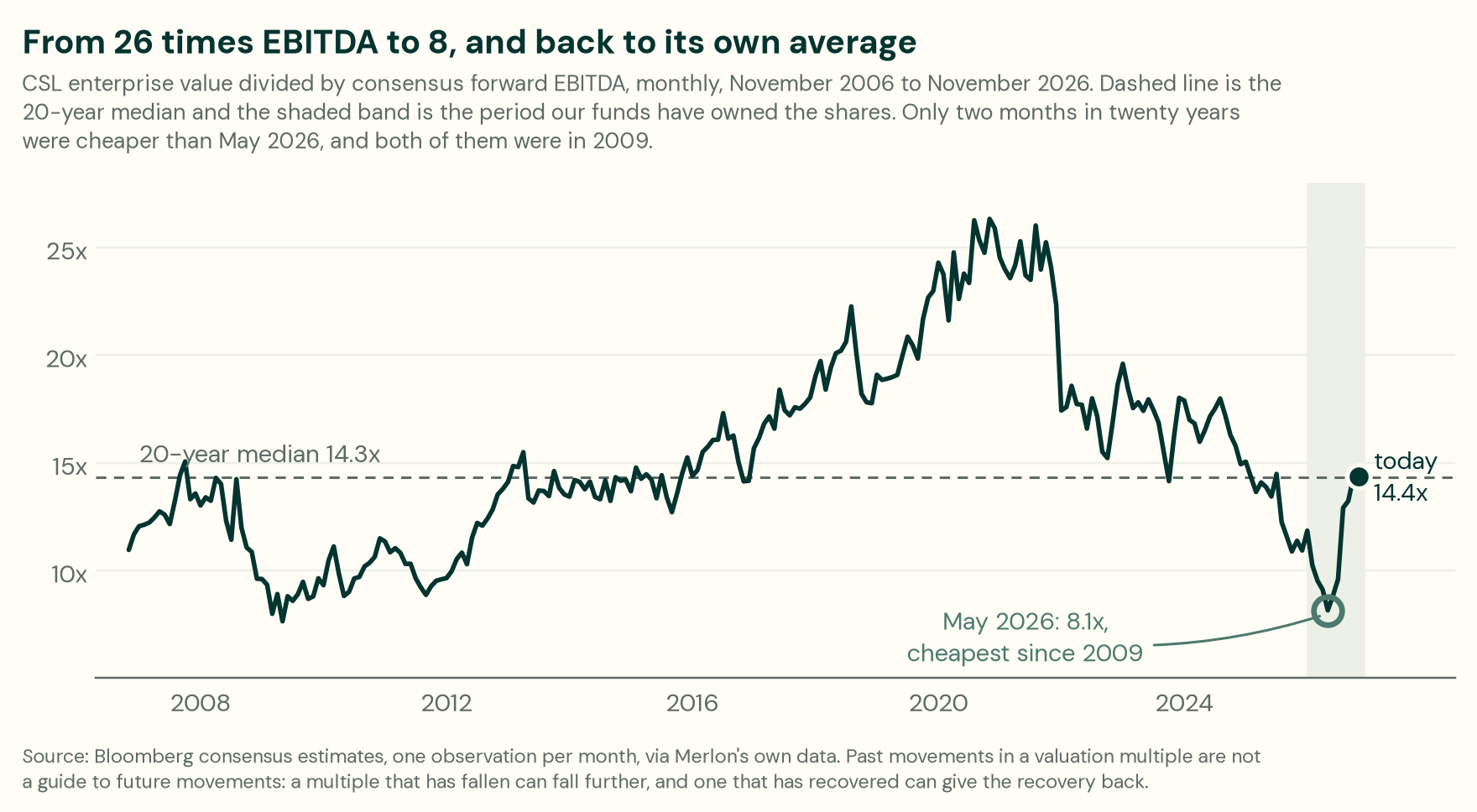
For a decade the market paid for CSL as a compounding machine, and the multiple it was prepared to pay very nearly tripled: from under 10 times expected earnings before interest, tax, depreciation and amortisation at the end of 2011 to more than 26 times in late 2020. Nothing we could see in the plasma business justified paying that, so we didn't.
What changed
Through 2025 and into 2026 the case the market had paid for came apart in public. Competitors closed CSL's plasma collection cost advantage. Its specialty products lost share. Chinese albumin demand fell away as the government tightened reimbursement. Generic competition arrived for Vifor, bought at a high price in 2022. American flu vaccination rates kept falling. Management withdrew its own timetable for margin recovery, and then the leadership changed.
Our conviction score went the wrong way before it went the right way: down in September 2025, down again in February 2026 after a first-half result showing Behring revenue 7% lower, and only up in June — five months after we had started buying.
None of this was quick. There are 32 dated notes on CSL in our research file, the first from February 2021. Twenty-three were written before we owned a single share.
Buying while it fell
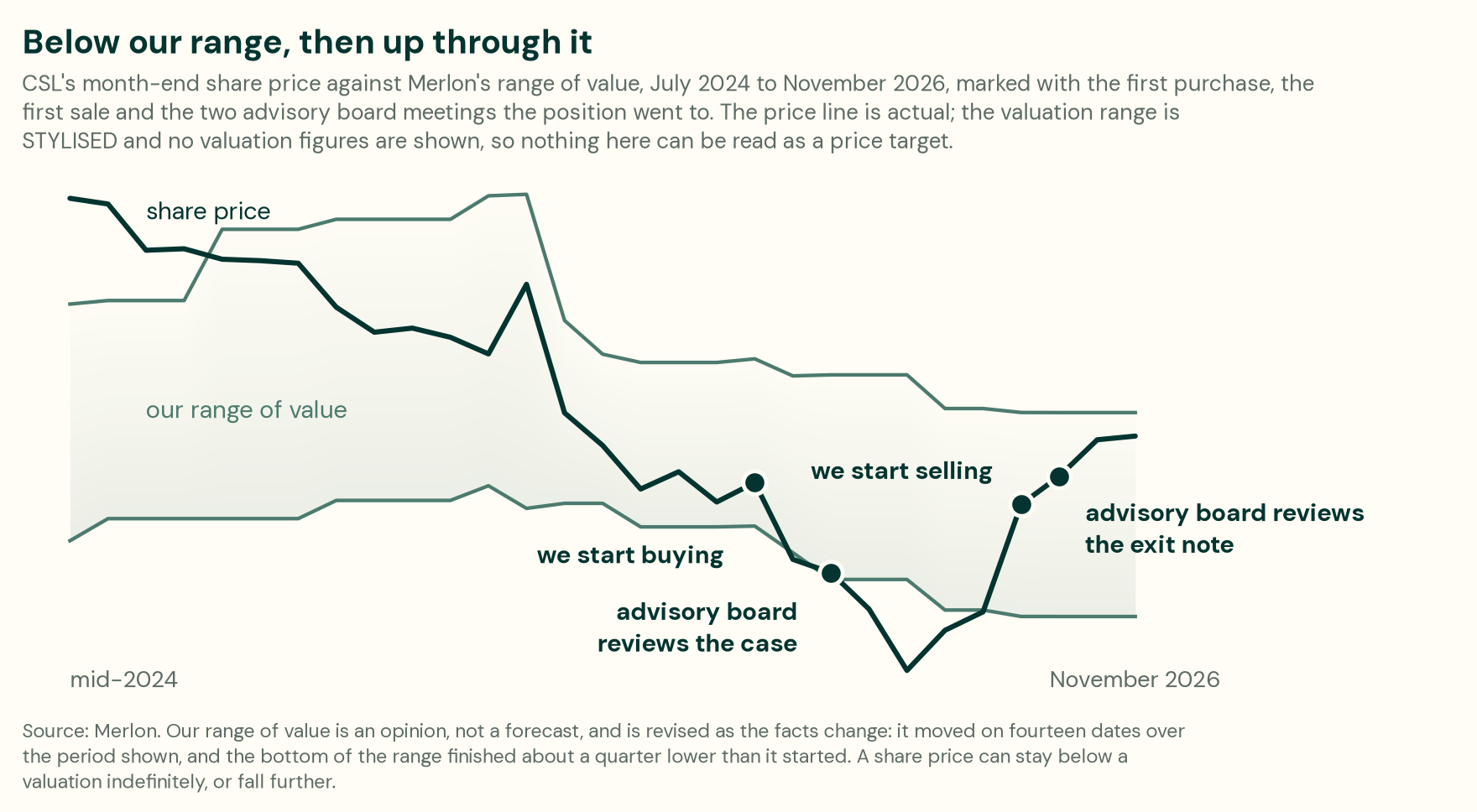
By early 2026 the share price had dropped through the bottom of our range of value — the figure we think the business is worth if most things go wrong. We started buying on 13 January and kept buying as the price kept falling: about $181 at the end of January, $147 in February, $124 in April, and $96.61 at the end of May.
That May price put CSL on about eight times expected EBITDA. In 20 years of history, only two had been cheaper, and both of them were in 2009.
Buying while a price falls is uncomfortable, and it is meant to be. It is also the only way a valuation discipline can work: if we only bought what the market had already forgiven, we would be paying for the forgiveness. In March, with a little over 2% of the fund in the stock, Joey put the case to our advisory board — the step our process asks for before a position is completed. The board's job is to test the thinking, not to approve the trade. The letter we write to the directors of every company we buy sat in the same pack, and went to CSL's board in April.
We had no view on when the shares would recover, and we did not need one. That is what a long-term horizon buys: the ability to be early without being forced out.
The result, and two days later
On 18 August CSL reported its full-year result. Behring revenue was growing again, the collapse in albumin had moderated, cash conversion had improved and net debt had fallen. The shares rose 17% that day, 27% over three sessions, and 39% across August.
On 21 August we started selling.
What "long term" actually means
A long-term horizon is a willingness, not a promise. It means we will look through noise, and hold for years if that is what it takes. The crucial words are if that is what it takes. We do not buy looking for a quick profit — but we do not stay for the sake of staying either.
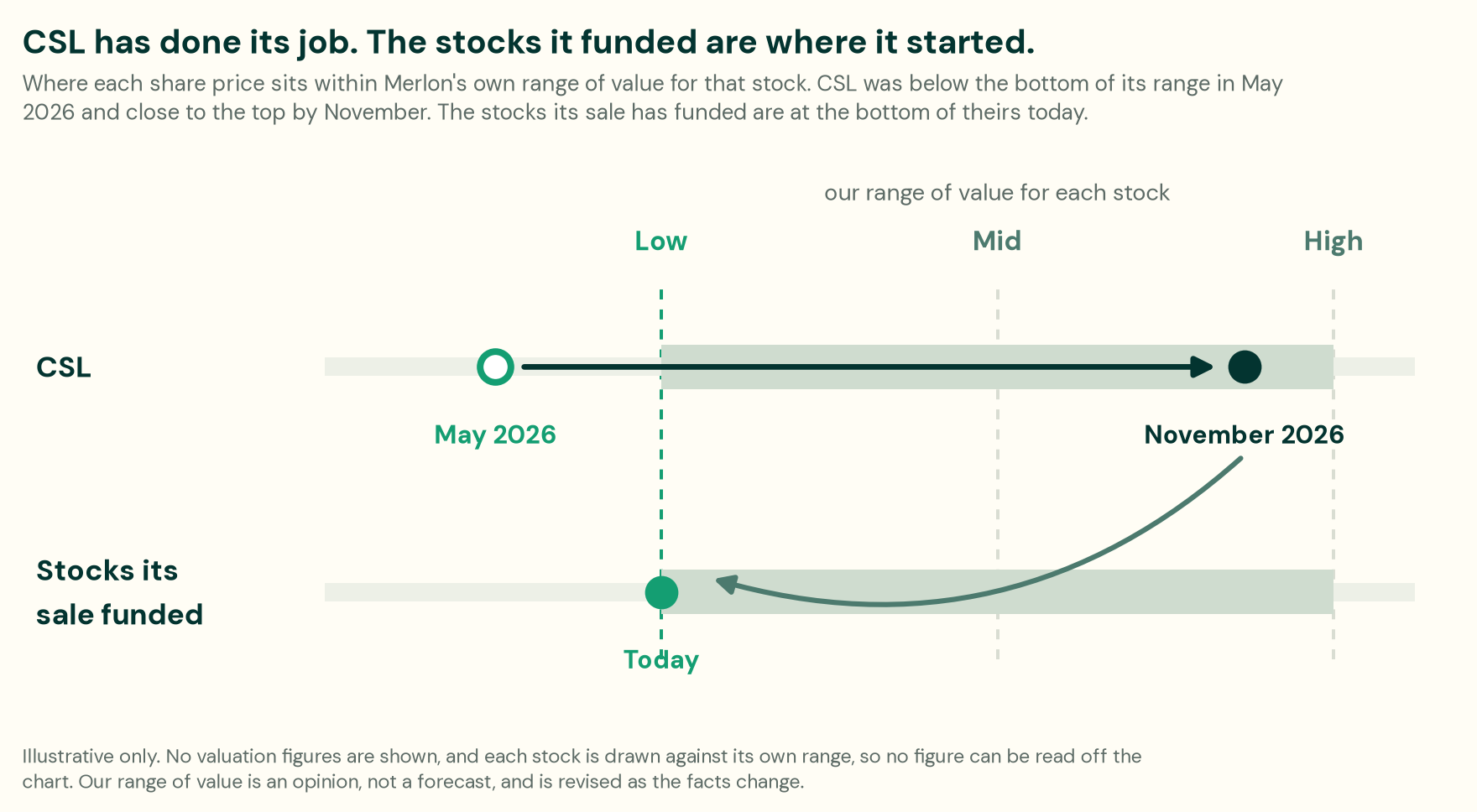
When the price moves, the arithmetic moves with it. In May, CSL traded well below our low case. By early November it was within 5% of the top of our range and back on its twenty-year average multiple of about 14 times EBITDA — fair, we think, for a company growing more slowly than its history with a weaker product mix. Nothing about the business had to be re-judged for the position to stop earning its place. The price did the re-judging, and the process takes over: money moves to wherever the gap between price and value is widest, and in August that stopped being CSL.
We may have sold too early
The way we would be wrong here is obvious. CSL keeps recovering, the multiple runs past its average, and we gave up the best part of the return. That has happened to us before and it will happen again. Selling into a recovery always leaves something on the table; it is the cost of a discipline that also stops us holding things which have stopped being cheap. And our range of value is an opinion — revised fourteen times over the two years charted above, finishing about a quarter below where it started. We are not immune to being wrong in either direction.
Where it stands
We still own CSL. On 5 November it was 2.8% of the Concentrated Australian Share Fund — a little over half its end-August weight — and 2.0% of the Australian Share Income Fund.
In September the same board that had tested the case in March read the exit note. Its job either way is to ask whether we are telling ourselves a story.
